Research
My research follows one pattern: take an expensive step in materials discovery or manufacturing, build a model that puts physical structure into the learning problem, and show it beats the existing approach on speed, cost or accuracy. The same approach carries into my industry work.
PhD Research
Graduate Research Assistant
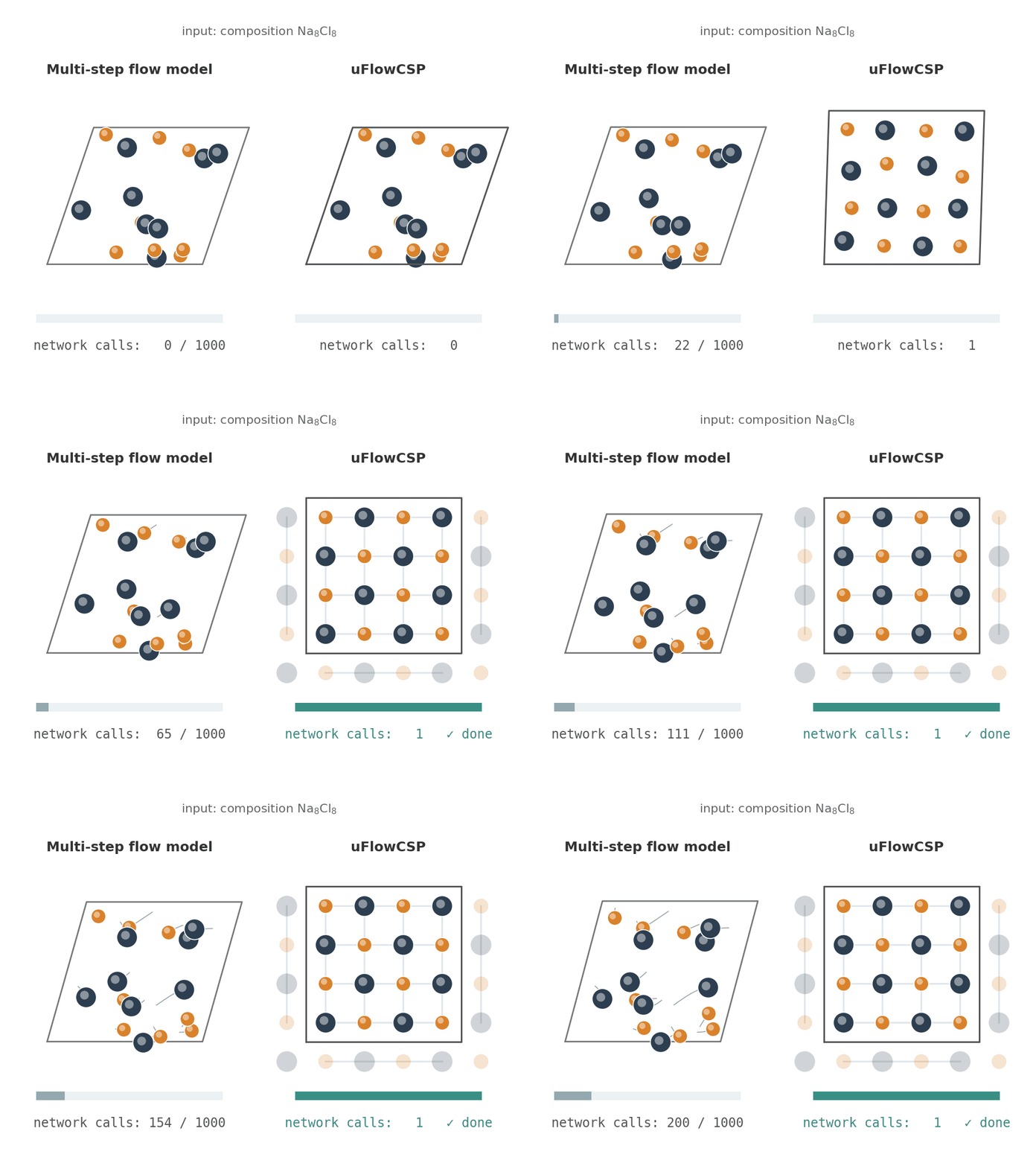
uFlowCSP: single-step generative model for crystal structure prediction. Discovering a new material starts with predicting how its atoms pack together, and the generative models that do this well are slow: every candidate structure costs hundreds to thousands of sequential network calls, so screening a chemical space burns hours of GPU time. I built a model that produces a complete crystal in one network evaluation by learning the average velocity of the generative trajectory instead of the instantaneous one. On the MP-20 benchmark, one step matches CrystalFlow's match rate (78.4% vs 78.3%) with 100× fewer network evaluations, and five steps reach 83.6%, ahead of CrystalFlow (78.3%, 2,000 evaluations) and DiffCSP (77.9%, about 20,000 evaluations). Generating 10,000 structures takes 0.4–1.3 minutes, against 6.5 minutes for CrystalFlow and 76 minutes for DiffCSP. The hard part was conditioning: a Transformer over atoms with chemistry-aware ordering and composition features, plus a symmetry signal used only during training, so the deployed model needs nothing but a chemical composition to run. Paper link.

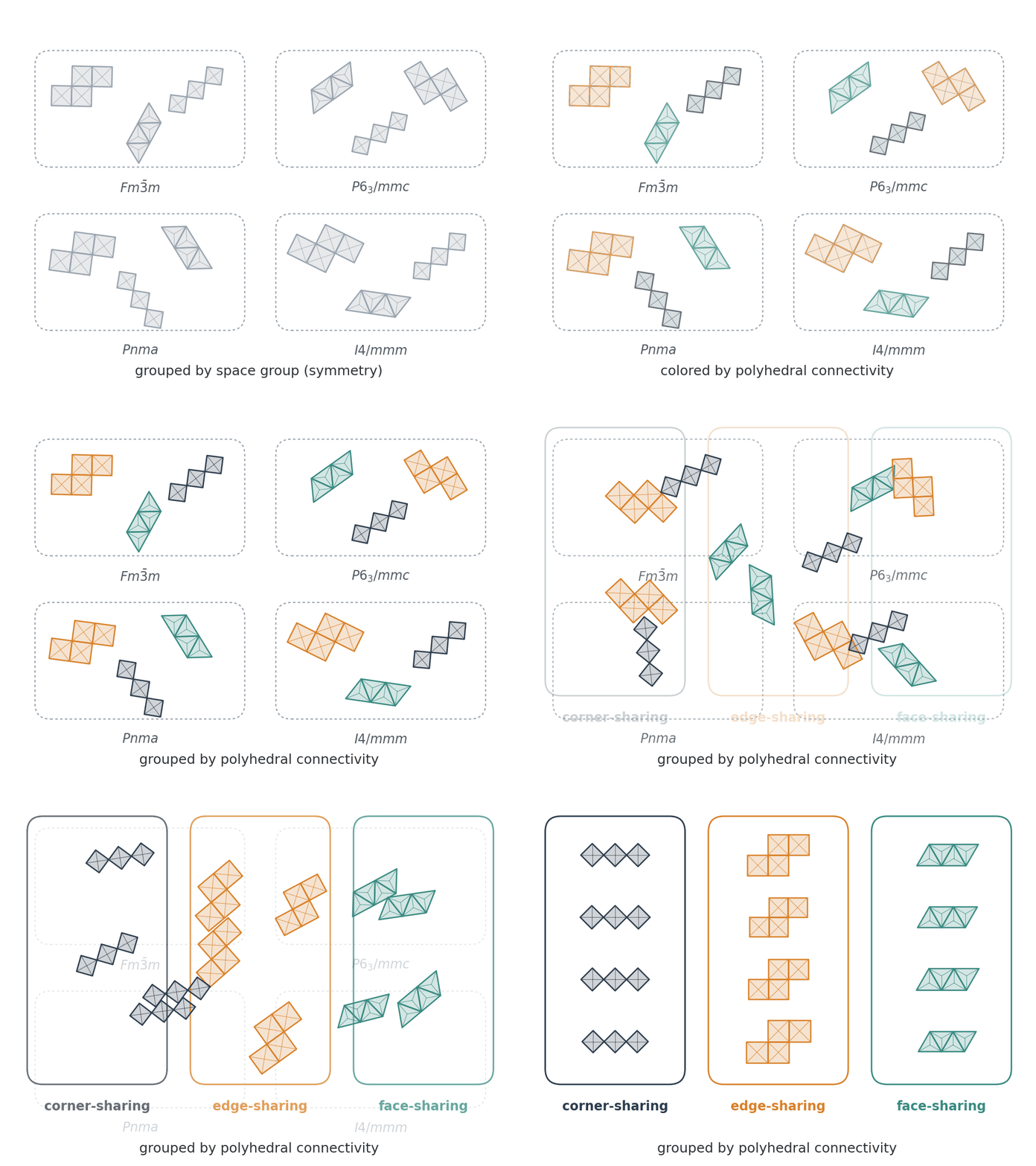
Polyhedron topology based mapping algorithm for polymorphic crystal structures - I developed polyhedron connectivity based graph topology to cluster materials across diverse space groups, improving identification of structural similarities beyond symmetry-based methods. Paper link.

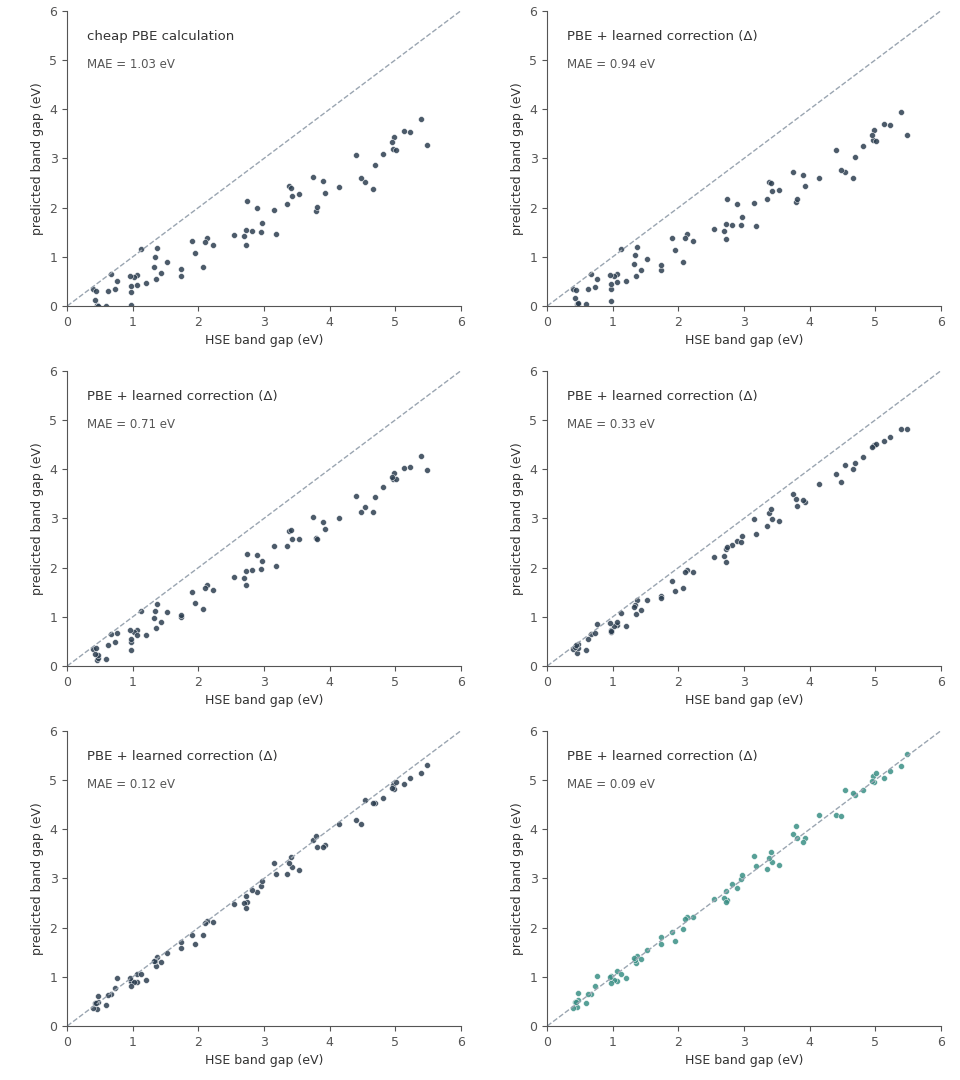
Developed a variant of Atomistic Line Graph Neural Network (ALIGNN) model by Δ-learning electronic structure of crystals to predict HSE eigenvalues, a key opto-electronic property. By leveraging inexpensive PBE calculations and orbital projections, I could build highly accurate ML model as surrogate for costly DFT calculation.
August 2021 - Present
MS Research
Graduate Research Assistant
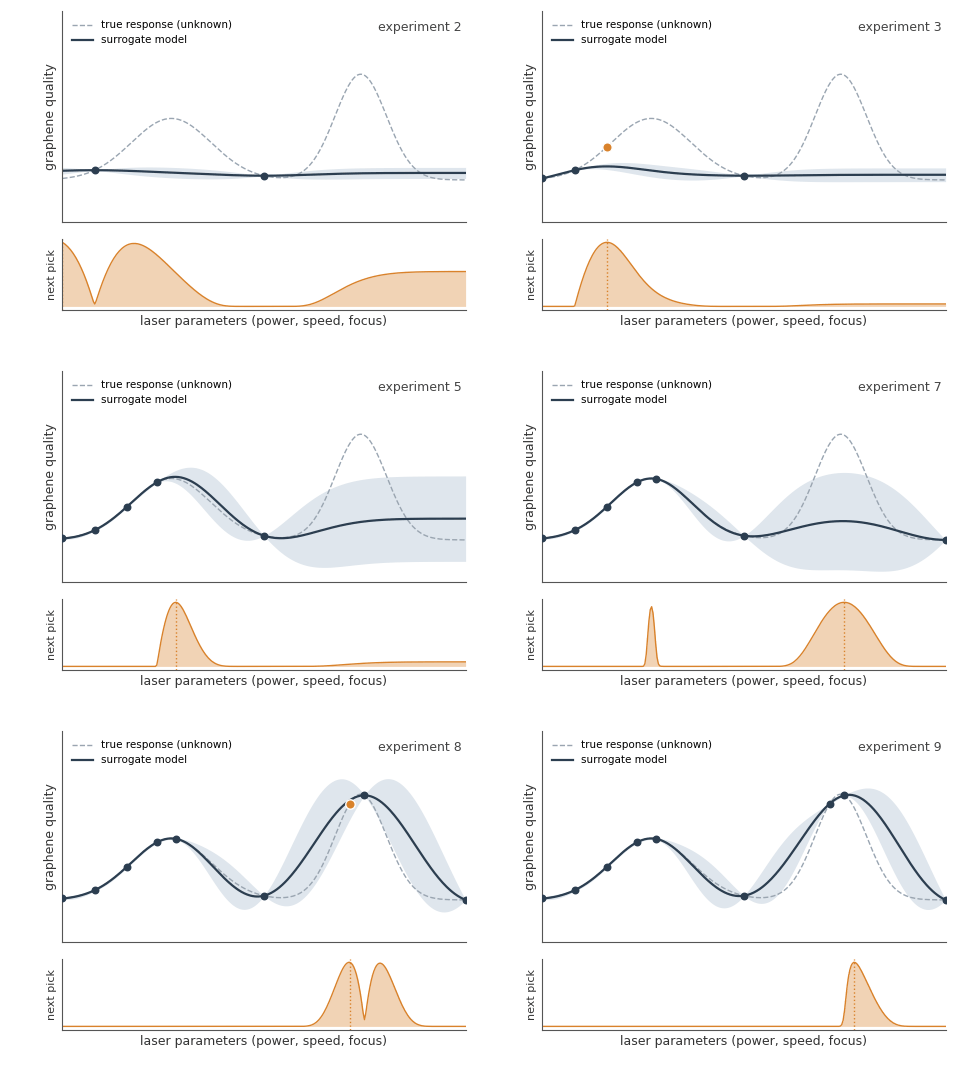
I automated the AI powered Laser-Induced Graphene Process(LIG) manufacturing using Bayesian Optimization. This is a small-data problem: each experiment is a physical run, so the system uses Bayesian model-based optimization to improve outcomes from little initial data. It improved on previous results in graphene quality across several precursor materials, and its robustness was tested across experimental conditions. The automated system is generalized and can be deployed to manufacture other materials. Paper link.
August 2019 - July 2021
Undergraduate Thesis
Formant-based Perceptual Space Classification is focused on detecting the Bengali vowel from
continuous speech. High Accuracy by SVM RBF Kernel Classifier is gained. This will enhance the
emotional state recognition research in the Bengali language.
June 2017 - May 2018