Sourin Dey

Sourin Dey

Columbia, South Carolina · sourin@email.sc.edu

I am doing PhD in Computer Science at the University of South Carolina with Deep Learning and Data Science specialization

Internship Experience

Data Science Intern

The Dow Chemical Company

Designed an AI-enabled product selector that works across multiple data modalities. I carried the project end to end, from reading source data out of SharePoint to deploying the application for internal use. I also built an automated data ingestion pipeline so the underlying data refreshes on its own and the selector stays current without manual updates.

Summer 2026

Data Science Intern

Hexagon Manufacturing Intelligence

Graph Retrieval-Augmented Generation (Graph-RAG) pipeline using Open Source and Azure Models: I built a Q/A system to process and query 20 years of software manuals. Using LangChain framework, I converted document knowledge into a neo4j-based graph database to retrieve information that is contextually rich and useful enough to assist Applications Engineers. Delivered scalable knowledge access – Enabled engineers to efficiently search and extract insights of multi-fold difficulties (temporal, vague, reasoning) from extensive technical documentation.

Summer 2025

Data Science Intern

The Dow Chemical Company

Developed a Graph Neural Network (GNN) framework – Built a heterogeneous network graph for product recommendation using node classification. I ensured effective information flow in non-homogeneous graphs to improve recommendation accuracy. Researched Variational Autoencoder (VAE) applications – I explored generative modeling for novel product formulation based on graph structures. I also identified how large, dense graphs bias the latent space and hinder stable VAE training.

Summer 2024

Research Experience

PhD Research

Graduate Research Assistant
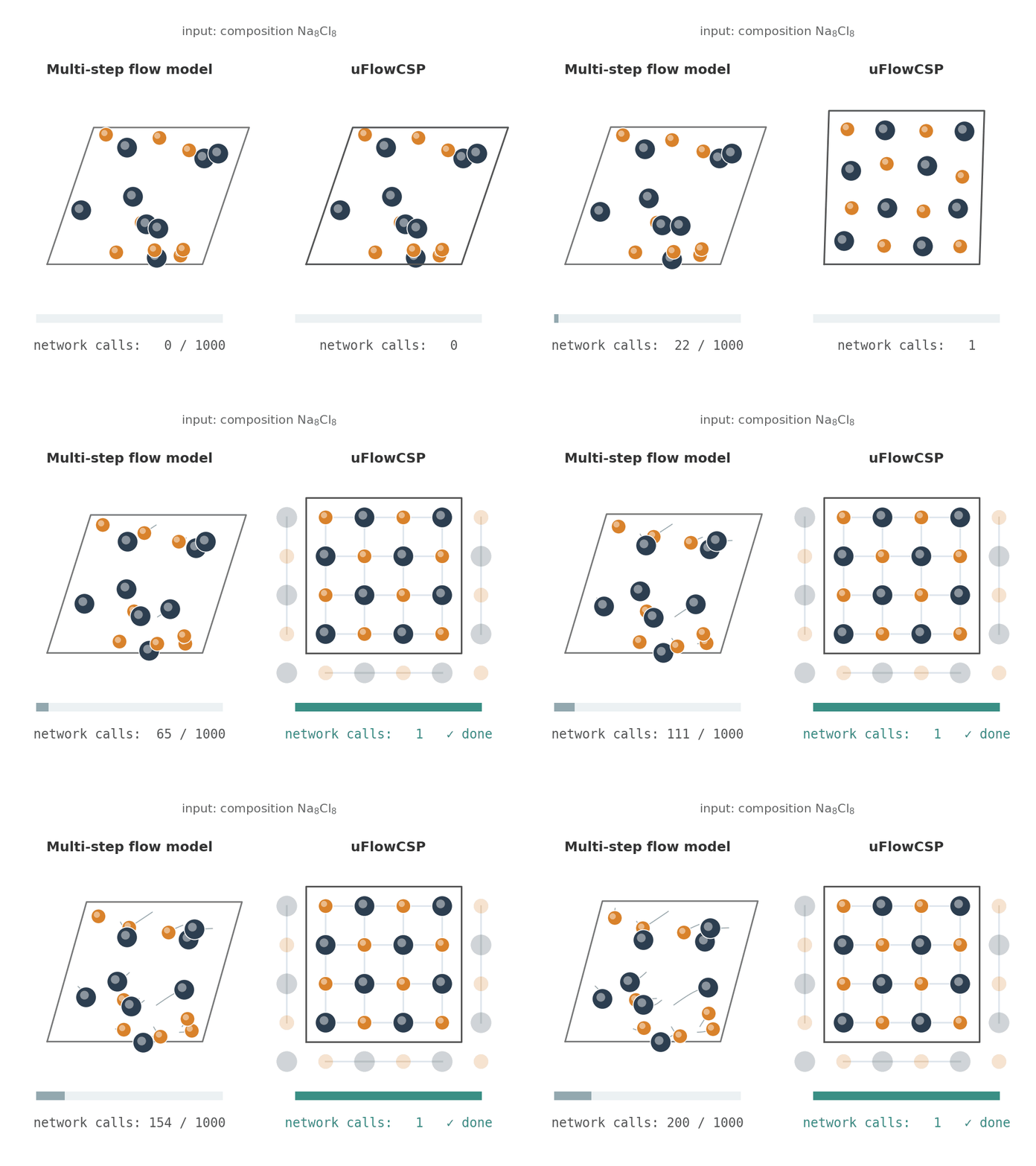
  • MFCSP: single-step generative model for crystal structure prediction. Discovering a new material starts with predicting how its atoms pack together, and the generative models that do this well are slow: every candidate structure costs hundreds to thousands of sequential network calls, so screening a chemical space burns hours of GPU time. I built a model that produces a complete crystal in one network evaluation by learning the average velocity of the generative trajectory instead of the instantaneous one. A screening run of ten thousand candidates drops from over an hour to under a minute, with accuracy that matches or beats the multi-step models it replaces. The hard part was conditioning: a Transformer over atoms with chemistry-aware ordering and composition features, plus a symmetry signal used only during training, so the deployed model needs nothing but a chemical formula to run. I also ran the first multi-seed study on this benchmark and found run-to-run spread wide enough to swamp most published architectural claims.
  • Machine learning pipeline for crystal generation
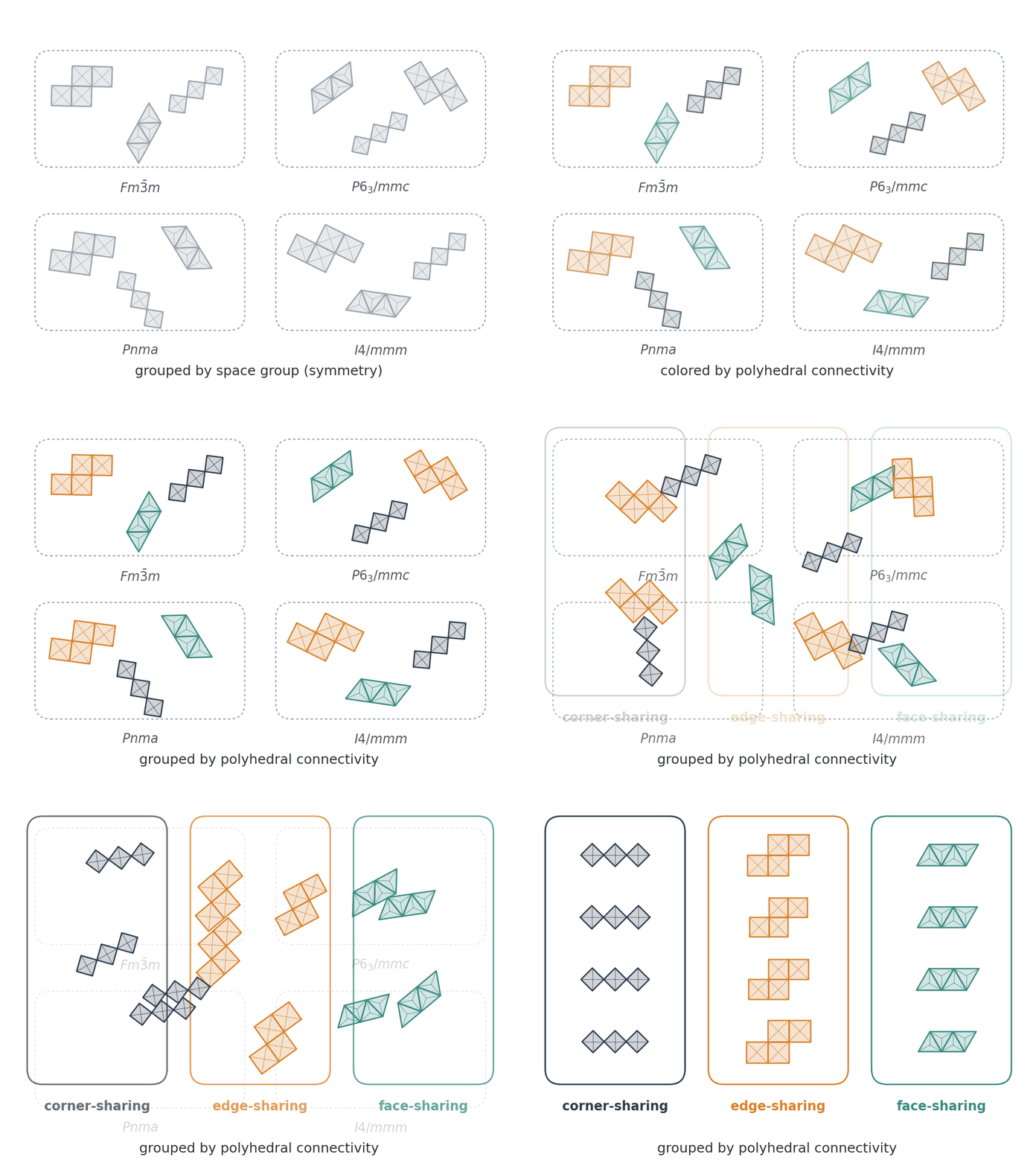
  • Polyhedron topology based mapping algorithm for polymorphic crystal structures - I developed polyhedron connectivity based graph topology to cluster materials across diverse space groups, improving identification of structural similarities beyond symmetry-based methods. Paper link.
  • Polyhedron topology based mapping visualization
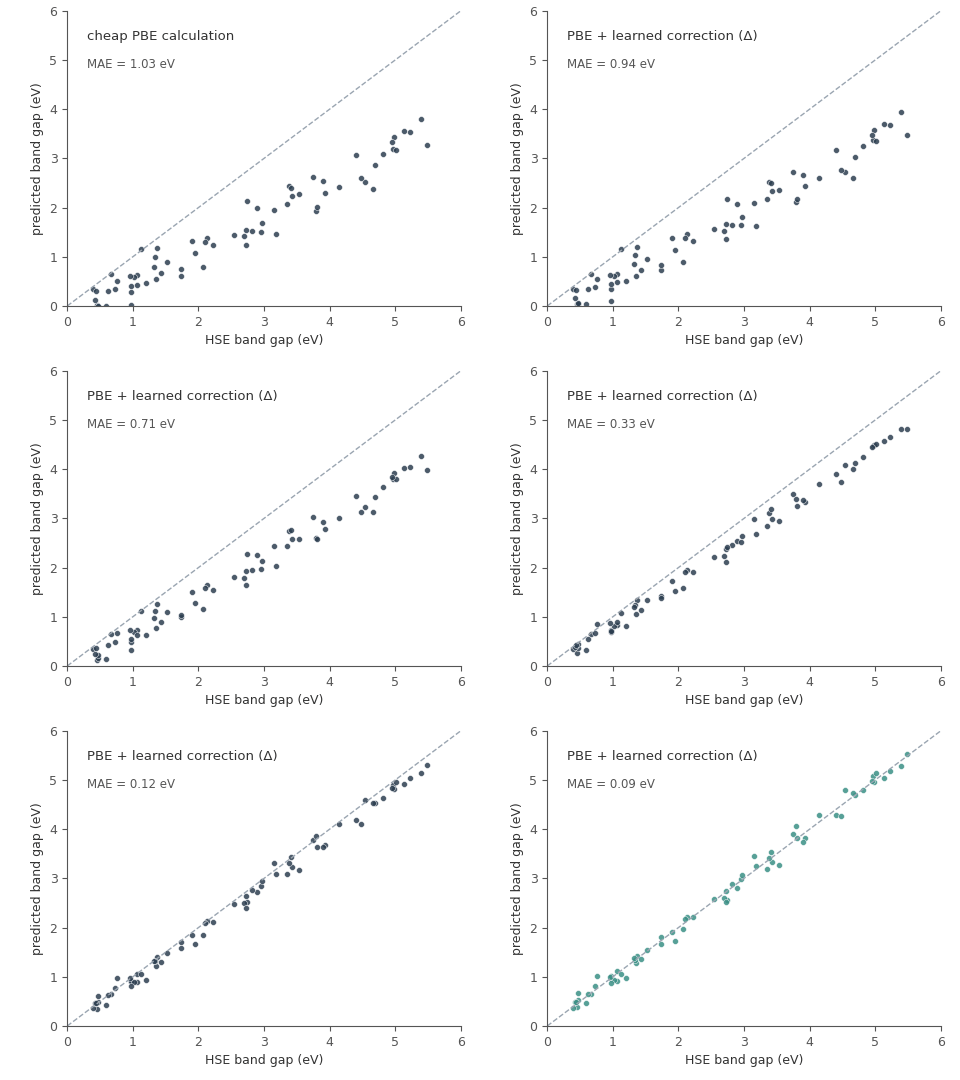
  • Developed a variant of Atomistic Line Graph Neural Network (ALIGNN) model by Δ-learning electronic structure of crystals to predict HSE eigenvalues, a key opto-electronic property. By leveraging inexpensive PBE calculations and orbital projections, I could build highly accurate ML model as surrogate for costly DFT calculation.
  • August 2021 - Present

    Research Experience

    MS Research

    Graduate Research Assistant

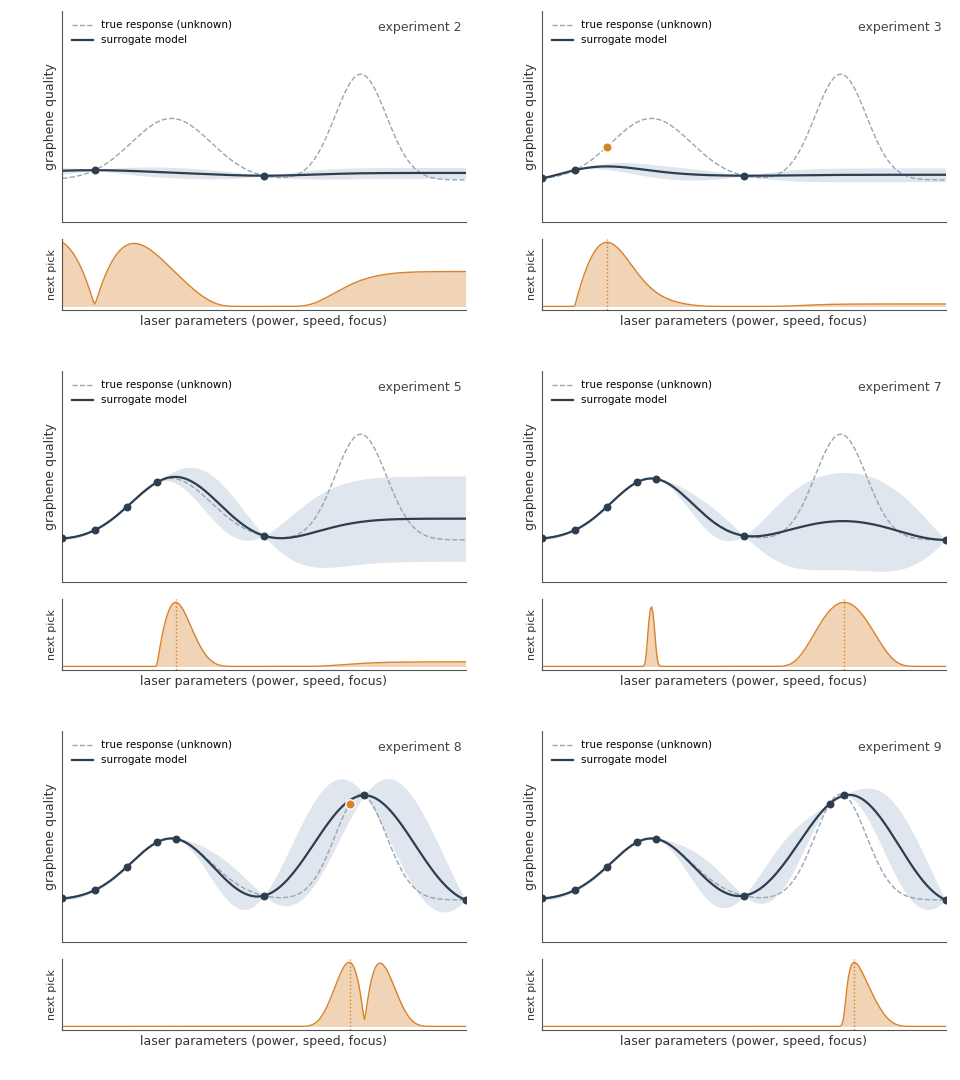
    I automated the AI powered Laser-Induced Graphene Process(LIG) manufacturing using Bayesian Optimization. The automated system is generalized and can be deployed to manufacture other materials.

    August 2019 - July 2021

    Undergraduate Thesis

    Formant-based Perceptual Space Classification is focused on detecting the Bengali vowel from continuous speech. High Accuracy by SVM RBF Kernel Classifier is gained. This will enhance the emotional state recognition research in the Bengali language.

    June 2017 - May 2018

    Education

    University of South Carolina

    Doctorate - Computer Science
    Selected Courses: Data Mining & Warehousing, Computer Processing of Natural Language, Neuromorphic Computing
    August 2021 - Present

    University of Wyoming

    Master - Computer Science
    Selected Courses: Intro to AI, Deep Reinforcement Learning & Control, Randomness in Computation
    August 2019 - July 2021

    Khulna University of Engineering & Technology

    Bachelor of Science - Electrical and Electronic Engineering
    Selected Courses: Digital Image Processing, Digital Signal Processing
    April 2014 - May 2018

    Skills

    Programming Languages & Tools
    • C
    • C++
    • High Performance Computing
    • Shell Scripting
    • Python (PyTorch, Pytorch-Geometric,Tensorflow, Deep Graph Library, GenSim, SpaCy), Pydantic AI, LangChain, LangGraph, Neo4j
    • R(mlrMBO,mlr,caret)
    • SQL
    • Github Copilot
    • Jupyter Notebook
    • VS Code
    • Algorithm & Data Structure coding in Leetcode
    • C++, C, Android Studio with Java Programming
    • Linux, Windows, Android
    • Git
    • Microsoft Office, LaTex

    Publications


    Extracurriculars

    I have interests in wildlife photography. During my master's days, I explored rural Wyoming and countrysides of the colorful Colorado. Have a look of my stills of the places Wyoming Days!!

    Instructor, Dept. of Chemistry & Biochemistry, University of South Carolina. Worked as an instructor for Python Programming Summer Camp Workshop.